> ## Documentation Index
> Fetch the complete documentation index at: https://docs-evisyn.grabmywork.com/llms.txt
> Use this file to discover all available pages before exploring further.
# Deduplication
> 4-layer duplicate detection to clean your paper library
When searching multiple databases, the same study often appears more than once. EviSyn uses a multi-layered approach that catches **95%+** of duplicates — including near-matches that traditional tools miss.
## Running Deduplication
Navigate to **Deduplication** from your project dashboard.
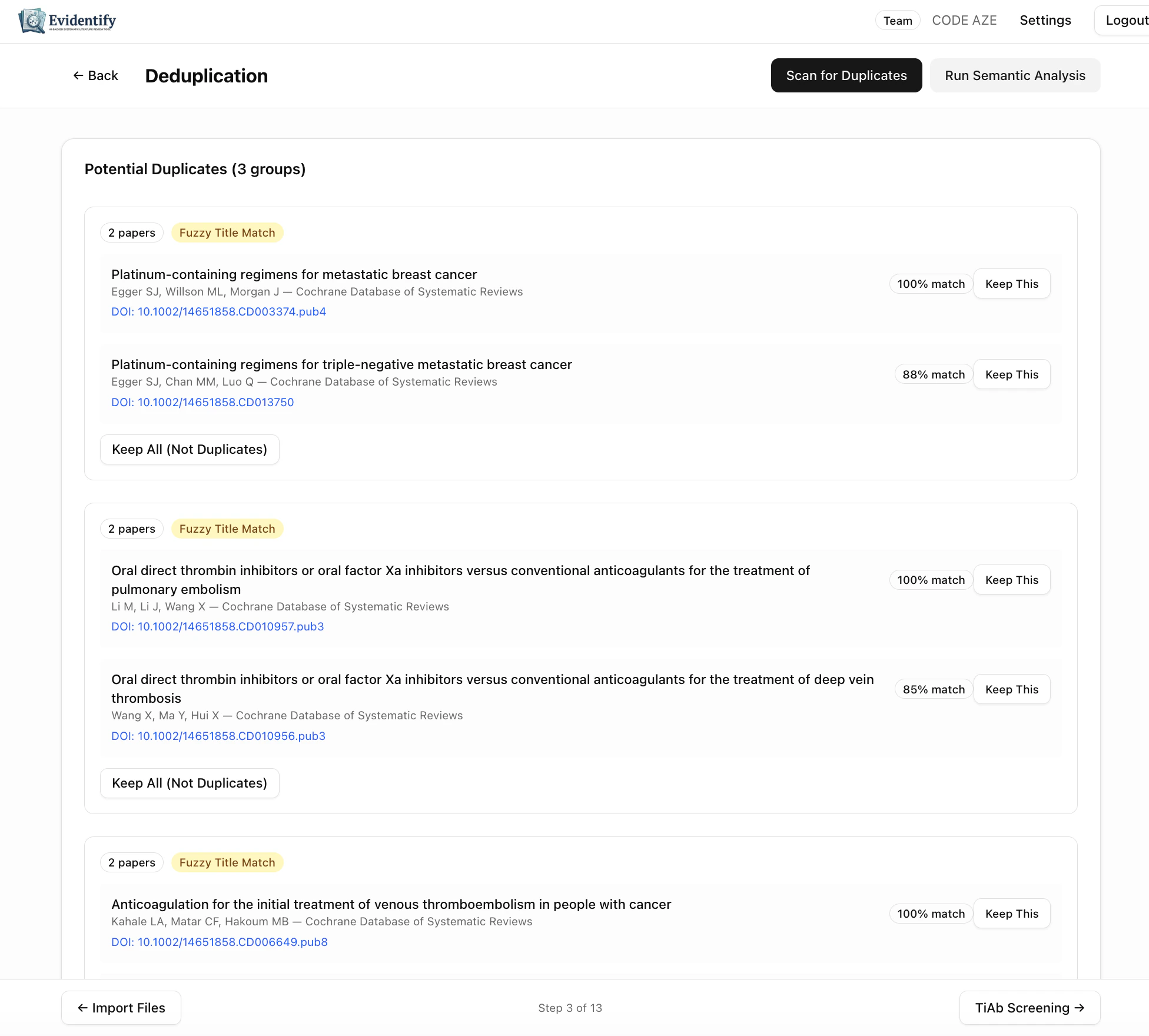 You have two scan options:
Fast scan using DOI matching, exact title matching, and fuzzy title matching (85%+ similarity). Takes seconds.
Deep scan using AI-powered semantic similarity. Catches papers that describe the same study with completely different wording. Takes longer but finds more duplicates.
## The 4 Detection Layers
| Layer | Method | What it catches |
| ----- | --------------- | ----------------------------------------------------------------------- |
| 1 | **Exact DOI** | Identical papers with the same DOI across databases |
| 2 | **Exact title** | Same title with different formatting or capitalization |
| 3 | **Fuzzy title** | Titles with slight differences (abbreviations, typos) — 85%+ similarity |
| 4 | **Semantic** | Papers describing the same study in completely different words |
## Reviewing Duplicate Groups
Each group of potential duplicates shows:
* **Match type** badge (e.g., "Fuzzy Title Match")
* **Similarity score** for each paper (e.g., 100%, 88%, 85%)
* Full metadata: title, authors, journal, DOI
### Resolution Options
For each group, you can:
| Action | What it does |
| ----------------------------- | ------------------------------------------------------------------------- |
| **Keep This** | Designate this paper as the primary record |
| **Keep All (Not Duplicates)** | Mark all papers in the group as unique — they are not actually duplicates |
Always check the DOIs and author lists before resolving. Fuzzy matches sometimes catch related but distinct papers (e.g., study protocol vs. results paper).
## What's Next?
Once all duplicate groups are resolved, proceed to [AI Screening](/user-guide/ai-screening) to screen your papers.
You have two scan options:
Fast scan using DOI matching, exact title matching, and fuzzy title matching (85%+ similarity). Takes seconds.
Deep scan using AI-powered semantic similarity. Catches papers that describe the same study with completely different wording. Takes longer but finds more duplicates.
## The 4 Detection Layers
| Layer | Method | What it catches |
| ----- | --------------- | ----------------------------------------------------------------------- |
| 1 | **Exact DOI** | Identical papers with the same DOI across databases |
| 2 | **Exact title** | Same title with different formatting or capitalization |
| 3 | **Fuzzy title** | Titles with slight differences (abbreviations, typos) — 85%+ similarity |
| 4 | **Semantic** | Papers describing the same study in completely different words |
## Reviewing Duplicate Groups
Each group of potential duplicates shows:
* **Match type** badge (e.g., "Fuzzy Title Match")
* **Similarity score** for each paper (e.g., 100%, 88%, 85%)
* Full metadata: title, authors, journal, DOI
### Resolution Options
For each group, you can:
| Action | What it does |
| ----------------------------- | ------------------------------------------------------------------------- |
| **Keep This** | Designate this paper as the primary record |
| **Keep All (Not Duplicates)** | Mark all papers in the group as unique — they are not actually duplicates |
Always check the DOIs and author lists before resolving. Fuzzy matches sometimes catch related but distinct papers (e.g., study protocol vs. results paper).
## What's Next?
Once all duplicate groups are resolved, proceed to [AI Screening](/user-guide/ai-screening) to screen your papers.